How Automation Systems Improve Efficiency in Manufacturing Plants
Manufacturing plants do not become efficient because someone installs a few robots and hangs a dashboard in the control room. Real efficiency comes from control, consistency, speed, and visibility, all working together without creating new bottlenecks somewhere else. That is where automation systems earn their keep. When they are designed well, they reduce wasted motion, tighten process control, improve throughput, and give plant teams faster ways to solve problems before those problems become expensive.
I have seen plants chase efficiency with overtime, tighter supervision, and heroic maintenance work, only to discover that the real issue was process instability. A line that runs fast for two hours and then stops for twenty minutes is not efficient. A packaging cell that depends on one highly experienced operator to keep it balanced is not efficient either. Industrial automation changes that equation by making performance more repeatable. It lets plants move from reacting to conditions to managing them.
That matters across nearly every segment of manufacturing, from food processing and pharmaceuticals to automotive, metals, plastics, and consumer goods. The products differ, the compliance rules differ, and the production economics differ, but the same pattern shows up again and again. If you can automate routine decisions, coordinate equipment, collect accurate data, and keep quality within limits, you can usually produce more with the same footprint and less waste.
Efficiency starts with consistency, not speed
People often talk about manufacturing automation as a way to make lines run faster. Sometimes it does. More often, the first gain is consistency. That may sound less dramatic, but in practice it is usually more valuable.
Consider a filling line for liquid products. If fill levels drift because of pressure variation, temperature changes, or inconsistent manual adjustments, the plant pays for that instability several ways. It gives away product through overfill, risks complaints or regulatory issues through underfill, and slows the line because operators keep stepping in to correct the process. An automated control loop tied to reliable sensors can hold that process much tighter than manual intervention alone. The line may not need to run at a much higher top speed to deliver better output by the end of the shift. It simply spends less time off target.
That same principle applies to ovens, mixers, conveyors, presses, sortation systems, and CNC equipment. Stable operation means fewer interruptions. Fewer interruptions mean less scrap, fewer restarts, less wear from repeated cycling, and a better chance of hitting daily production goals without last-minute chaos.
This is one reason factory automation often produces results that surprise leadership teams. They may approve a project hoping for a ten percent speed increase and find that the real benefit comes from a fifty percent reduction in micro-stoppages, rework, and labor spent on manual adjustments. Those gains tend to hold because they are built into the process rather than dependent on who happens to be on shift.
Where the biggest efficiency gains usually appear
Automation affects efficiency in layers. Some gains are obvious on the line. Others show up later in maintenance records, quality reports, energy use, and scheduling performance.
A plant that moves from isolated machines to coordinated automation systems usually sees improvement in several areas at once:
- cycle times become more predictable, which makes planning more accurate
- changeovers become faster because recipes and equipment settings can be recalled automatically
- scrap and rework fall when sensors and interlocks catch problems early
- labor shifts away from repetitive manual tasks toward oversight, quality, and troubleshooting
- downtime becomes easier to diagnose because controls and data systems record what happened
Those five changes may sound straightforward, but together they can transform how a plant operates. Predictable cycle times reduce the need to pad schedules. Faster changeovers make smaller batch sizes more practical. Lower scrap improves margin without asking sales to win another account. Better downtime analysis turns maintenance meetings from guesswork into action.
In one mid-sized packaging operation I visited years ago, the line did not look especially outdated. The conveyors ran, the wrappers ran, and the case packers ran. Yet the plant constantly missed output targets. The problem was not one catastrophic failure. It was the accumulation of small inefficiencies: handoffs between machines were poorly timed, jam recovery required manual resets in several places, and no one had a clear record of where lost minutes were going. After the site upgraded controls, added line monitoring, and standardized fault handling, output improved without adding another shift. The management team had expected labor savings. What they got first was time, and time is often the most valuable form of efficiency in a plant.
The role of industrial automation in process control
When people outside manufacturing hear the term industrial automation, they often picture robotic arms welding car bodies. Robotics are part of the story, but process control is just as important, and in many plants it drives more day-to-day efficiency than robotics alone.
At the center of most industrial automation solutions are controllers, sensors, drives, human-machine interfaces, and software that coordinate what the process should do and how it responds when conditions change. That coordination matters because manufacturing is dynamic. Materials vary. Equipment heats up. Operators change rolls, parts, or tools. Utilities fluctuate. Demand shifts. Good automation absorbs normal variation and keeps the process within acceptable limits.
Take a baking operation. Dough moisture may drift from lot to lot. Oven zones may run hotter in one section than another. Conveyor loading can affect bake profile. If the process depends entirely on manual observation and occasional adjustment, variation accumulates quickly. A properly tuned automation system can monitor temperature, belt speed, product position, and downstream flow, then make small corrections continuously. Those corrections are usually invisible to anyone walking the floor, but they are exactly what preserve yield and reduce waste.
The same principle holds in discrete manufacturing. In an assembly plant, servo systems, vision systems, and torque tools can verify placement, orientation, and fastening parameters in real time. That keeps defects from moving downstream where they become more expensive to fix. Quality at the source is one of the clearest ways manufacturing automation improves efficiency. It prevents bad work from consuming more labor, more machine time, and more material.
Automation reduces the hidden cost of waiting
One of the least appreciated advantages of automation is how much waiting it removes from a plant. Waiting takes many forms. Machines wait for material. Operators wait for instructions. Maintenance waits for a clear fault description. Supervisors wait for production data that should already exist. Quality technicians wait to discover a problem that could have been flagged immediately.
These delays are expensive because they spread. A five-minute pause at one machine can become thirty minutes of disruption across an entire line if upstream and downstream processes are tightly linked. Automation systems reduce that spread by coordinating flow and exposing issues quickly.

Line control is a good example. In many plants, individual machines are capable of high performance on paper, but the line as a whole runs poorly because those machines do not communicate well. One unit starves, another blocks, and the operators spend the shift compensating manually. Centralized line control can manage accumulation, balance speeds, and sequence starts and stops so equipment behaves like a system rather than a collection of assets. That alone can lift effective throughput more than a faster machine ever would.
The data generated by automation also shortens the waiting that happens after a stop. If a machine fault history shows the same prox switch failure, drive overload, or upstream jam pattern every week, the maintenance team can act with confidence. Without that information, people often waste time debating causes, chasing symptoms, or replacing the wrong parts.
Better labor use, not simply fewer people
Discussions about factory automation often become simplistic. Either it is framed as a way to cut headcount, or it is rejected as too disruptive to the workforce. In reality, most successful plants use automation to improve how labor is deployed.
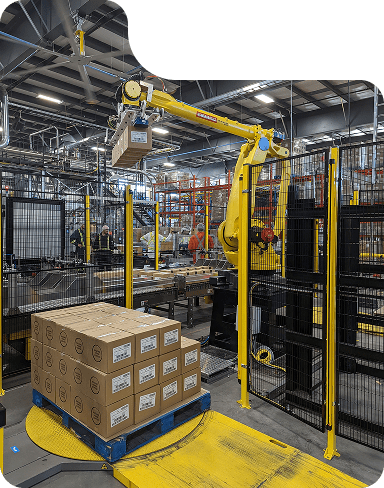
Repetitive manual tasks are hard on people and hard to sustain at high quality. Loading parts into a fixture for ten hours, manually palletizing heavy cases, or constantly adjusting machine settings is not a strong use of skilled labor. Automation can absorb the repetitive portion of the work while operators and technicians focus on monitoring, changeovers, inspections, material handling, and problem-solving.
That does not mean labor challenges disappear. Plants still need training. They still need technicians who can read a fault screen, understand process behavior, and escalate appropriately. They often need more electrical and controls expertise than before. But the best industrial automation solutions make skilled people more effective instead of forcing them to spend their shift on low-value activity.
A well-automated plant usually has fewer moments where one experienced operator is carrying the line through sheer intuition. That is an efficiency gain in itself. It reduces dependence on tribal knowledge and makes performance more resilient across shifts, vacations, and turnover.
Changeovers are where good automation pays back fast
Many manufacturers focus on run speed because it is easy to measure. Yet in mixed-product environments, changeovers often determine whether the plant feels efficient or constantly rushed. A line that runs beautifully for long campaigns may perform poorly if each product switch consumes an hour of manual setup, test runs, and fine tuning.
Automation helps by storing and recalling recipes, adjusting machine parameters automatically, guiding operators through setup steps, and verifying whether equipment is ready before the line restarts. In practical terms, that can mean servo-driven guides moving to the correct width, filler settings adjusting automatically for a new package size, code dates updating without manual entry, and vision systems checking label position before full production resumes.
Plants that produce multiple SKUs, short runs, or seasonal products benefit disproportionately from this kind of manufacturing automation. Saving fifteen or twenty minutes per changeover may not sound dramatic until you multiply it by six changes a day, five days a week, across a year. The capacity recovered can be substantial, and it often comes without the capital cost of a whole new line.
There is also a quality benefit. Manual setup creates opportunities for error, especially under schedule pressure. Automated recipe management reduces the chance that a line runs the right product with the wrong settings, which is exactly the kind of mistake that creates scrap, rework, and customer issues.
Visibility changes management behavior
A plant cannot improve what it cannot see clearly. Before automation data is collected and organized, performance conversations often rely on impressions. One shift believes the problem is materials. Another blames maintenance. Supervisors argue about whether the line really stopped for ten minutes or thirty. These debates consume energy without producing much insight.
Automation systems change the tone of those conversations. When controls, sensors, and supervisory software capture downtime events, reject counts, cycle times, and process values, the plant gains a factual starting point. That does not solve every problem automatically, but it keeps teams from wasting time on folklore.
The most useful production data usually answers a small set of practical questions:
- where is the line losing time
- what faults recur most often
- how much scrap is tied to process drift versus mechanical failure
- which changeovers run well and which do not
- whether a local fix actually improved performance over the following weeks
That kind of visibility supports better decisions at every level. Operators can respond faster during the shift. Maintenance can prioritize chronic losses rather than the loudest complaints. Engineers can justify improvements with evidence. Managers can stop pushing blanket speed increases when the real issue is reliability or changeover discipline.
I have seen sites install excellent line monitoring and then underuse it because they treated the software as a reporting tool rather than a management tool. The real value appears when teams review the data regularly, agree on the top loss, and assign ownership. Automation creates visibility, but disciplined follow-through is what turns visibility into efficiency.
Maintenance becomes more proactive
One of the strongest long-term benefits of industrial automation is its impact on maintenance. Traditional maintenance in many plants is reactive by habit, even when leadership claims otherwise. Teams fix what breaks, rush parts into stock, and move on to the next emergency. That cycle is exhausting and expensive.
Automation supports a more proactive approach in several ways. Fault diagnostics pinpoint issues faster. Drive and motor data reveal overload patterns. Cycle counts and runtime hours support maintenance scheduling based on actual use instead of rough calendar estimates. Condition indicators can flag temperature, vibration, pressure, or current abnormalities before they become failures.
This does not eliminate breakdowns. Sensors fail, wiring gets damaged, and equipment still wears out. But the plant gains earlier warnings and better context. In most cases, the first efficiency gain is reduced diagnosis time. A thirty-minute troubleshooting effort becomes a ten-minute one because the system identifies the failed device factory automation or the sequence step where the stop occurred. Over months, those recovered minutes add up.
There is a caution here. More automation can also introduce new maintenance demands if the plant is not ready for them. Sophisticated equipment without proper spare parts, documentation, and technician training can become a source of frustration. That is why successful automation projects include maintainability from the start. Access to components, clear alarm design, standard hardware platforms, and practical support documentation matter just as much as performance specs.
Energy and material efficiency often improve quietly
Not every automation benefit appears in throughput charts. Some appear in utility bills and material usage, and these gains can be significant, especially in high-volume operations.
Motor controls and variable frequency drives can reduce energy use by matching output to actual demand instead of running every system at full speed. Automated shutdown sequences prevent equipment from idling unnecessarily. Better process control reduces overconsumption of steam, compressed air, water, adhesives, coatings, and raw material. In thermal processes, tighter control can lower waste from overheating, underheating, or extended warm-up periods.
Material savings are often easier to win than leaders expect. Even small reductions in giveaway, trim loss, off-spec batches, or packaging waste can deliver strong returns. In plants with tight margins, these quiet gains may justify an automation project more convincingly than labor reduction ever could.
The trade-offs are real
Automation is not magic, and experienced plant leaders know that. The wrong project can create complexity without solving the core problem. A heavily automated process built on unstable material flow, poor layout, or weak production planning may simply automate the chaos.
Capital cost is the most obvious trade-off, but it is not the only one. Implementation disrupts operations. Controls integration takes planning. Operators and maintenance teams need training. Recipe management and data structures need discipline. Cybersecurity becomes part of plant reliability. Standardization matters more because custom one-off logic becomes difficult to support over time.
There is also a strategic judgment about where to automate. Not every manual task deserves a machine. In low-volume, high-mix operations, flexible manual work may outperform rigid automation. In some environments, semi-automation provides a better return than full automation because it improves safety and repeatability without adding excessive complexity.
The strongest industrial automation solutions are usually the ones that fit the plant's actual constraints. They solve a specific production problem, integrate with upstream and downstream reality, and can be supported by the people on site.
What separates good automation projects from disappointing ones
The plants that see lasting efficiency gains tend to approach automation with a practical mindset. They do not start by asking what technology looks impressive. They start by asking where time, quality, or capacity is being lost and what kind of control would materially improve the process.
A good project also measures success correctly. Nameplate speed is rarely enough. Throughput, uptime, first-pass yield, changeover time, labor utilization, and maintenance burden all matter. If a project increases speed but doubles nuisance faults, it may not be an efficiency win.
The best results usually come when operations, engineering, maintenance, and quality are involved early. Each sees different risks. Operators know where the workarounds are. Maintenance knows which devices are troublesome and which designs are serviceable. Quality knows where variation hurts the product. Engineering ties the system together. When one of those perspectives is missing, the project often pays for it later.
Why automation keeps gaining ground in manufacturing
The pressure on manufacturers is not easing. Customers want shorter lead times, more product variation, consistent quality, and competitive pricing at the same time. Labor markets remain uneven. Energy and material costs fluctuate. In that environment, plants need systems that make output more predictable and less dependent on constant intervention.
That is the core reason automation systems continue to spread. They help plants do more than move faster. They help them run with less variation, less waste, and better information. They make performance less fragile. And when they are chosen wisely, they create room for people to focus on the work humans handle best, judgment, troubleshooting, improvement, and coordination.
Efficiency in manufacturing is rarely about one dramatic breakthrough. More often, it comes from removing friction from hundreds of moments across a shift. A machine adjusts itself instead of waiting for an operator. A fault is diagnosed in minutes instead of half an hour. A recipe loads correctly the first time. A process stays centered instead of drifting into scrap. Industrial automation, factory automation, and broader manufacturing automation efforts matter because they compound these small wins until the plant operates differently.
That is the real value. Not flashy technology for its own sake, but a manufacturing environment that wastes less, responds faster, and delivers steady performance day after day.
Sync Robotics Inc. — Business Info (NAP)
Name: Sync Robotics Inc.Address: 2-683 Dease Rd, Kelowna, BC V1X 4A4
Phone: +1-250-753-7161
Website: https://www.syncrobotics.ca/
Email: [email protected]
Sales Email: [email protected]
Hours:
Monday: 8:00 AM – 4:30 PM
Tuesday: 8:00 AM – 4:30 PM
Wednesday: 8:00 AM – 4:30 PM
Thursday: 8:00 AM – 4:30 PM
Friday: 8:00 AM – 4:30 PM
Saturday: Closed
Sunday: Closed
Service Area: Kelowna, British Columbia and across Canada
Open-location code (Plus Code): VHWR+PQ Kelowna, British Columbia
Map/listing URL: https://maps.app.goo.gl/xwtV2wEu8ZuKH3se8
Embed iframe:
Socials (canonical https URLs):
LinkedIn: https://www.linkedin.com/company/syncrobotics/
Instagram: https://www.instagram.com/syncrobotics/
Facebook: https://www.facebook.com/syncrobotics/
https://www.syncrobotics.ca/
Sync Robotics Inc. is an industrial robot and controls integration company based in Kelowna, British Columbia.
The company designs and deploys automation solutions for manufacturing operations across Canada.
Services include industrial robotics integration, controls integration, automation system design, deployment support, and related manufacturing automation solutions.
Sync Robotics Inc. is located at 2-683 Dease Rd, Kelowna, BC V1X 4A4.
To contact Sync Robotics Inc., call +1-250-753-7161 or email [email protected].
For sales inquiries, email [email protected].
Hours listed are Monday to Friday 8:00 AM–4:30 PM, with Saturday and Sunday closed.
For directions and listing details, use the map listing: https://maps.app.goo.gl/xwtV2wEu8ZuKH3se8
Popular Questions About Sync Robotics Inc.
What does Sync Robotics Inc. do?Sync Robotics Inc. designs and deploys industrial robot and controls integration solutions for manufacturing operations.
Where is Sync Robotics Inc. located?
Sync Robotics Inc. is located at 2-683 Dease Rd, Kelowna, BC V1X 4A4.
Does Sync Robotics Inc. serve clients outside Kelowna?
Yes—Sync Robotics Inc. is based in Kelowna, British Columbia and serves clients across Canada.
What are Sync Robotics Inc.’s hours?
Monday–Friday: 8:00 AM–4:30 PM; Saturday and Sunday closed.
How can I contact Sync Robotics Inc.?
Phone: +1-250-753-7161
General Email: [email protected]
Sales Email: [email protected]
Website: https://www.syncrobotics.ca/
Map: https://maps.app.goo.gl/xwtV2wEu8ZuKH3se8
LinkedIn: https://www.linkedin.com/company/syncrobotics/
Instagram: https://www.instagram.com/syncrobotics/
Facebook: https://www.facebook.com/syncrobotics/
Landmarks Near Kelowna, BC
1) Kelowna International Airport2) UBC Okanagan
3) Rutland
4) Orchard Park Shopping Centre
5) Mission Creek Regional Park
6) Downtown Kelowna
7) Waterfront Park